Advanced Methods for Repairing Damaged Casings in Water Wells

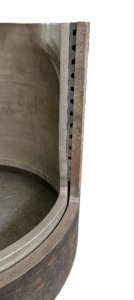
Cross-section of a hydroformed stainless-steel liner expanded against an existing well casing.

When water-well casings fail due to corrosion, breaches, or structural fatigue, the repair method must restore integrity without significantly reducing the wellbore’s internal diameter. This is critical because water wells are typically designed around the original casing size, with downhole equipment such as submersible pumps and packers selected to suit the original internal diameter. A substantial reduction in internal diameter can prevent reuse of the existing pump or downhole assembly, adding the cost and complexity of equipment replacement. It can also reduce the achievable flow rate or increase electricity consumption if the same flow is maintained, due to the higher pressure drop through the restricted section. As an alternative to conventional relining, the HydroFORM system uses hydroforming technology and inflatable packers to install a stainless-steel liner in place while minimising loss of wellbore diameter.

The core of this method utilises the HydroFORM system, an expandable stainless-steel tubular equipped with a vulcanised elastomer coating. By positioning a high-pressure inflatable packer inside this liner, the steel can be expanded in place, compressing the elastomer against the damaged casing to form a hydraulic seal. Depending on the extent and geometry of the casing damage, three primary hydroforming configurations can be used to restore well integrity.

Continuous HydroFORM Lining

For wells with localised casing breaches or a section of moderate damage, a continuous HydroFORM Liner™ can be deployed to cover the entire compromised zone. These expandable liners can be configured as a single continuous patch or multiple segments welded together to form a longer, unified seal.
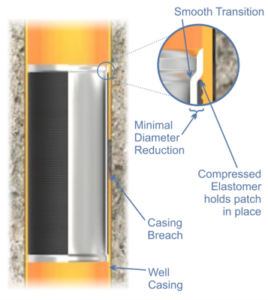
HydroFORM Liner™ showing smooth transition and minimal internal diameter reduction after casing repair.

During the hydroforming process, the elastomer coating compresses directly against the existing casing wall. This action creates a hydraulic seal along the interface and a compressed contact surface that anchors the liner in position.

Dual HydroFORM Liners with a Blank Mid-Section

When dealing with extended lengths of damaged casing, expanding a solid liner for the entire span may be unnecessary and time-consuming. In these scenarios, a straddle or dual HydroFORM configuration may be more appropriate. This configuration utilises hydroformed sections at the upper and lower extremities of the repair zone, with a standard blank liner between these two expandable ends. Once expanded, the top and bottom sections provide mechanical and hydraulic sealing, supporting the blank liner across the damaged span.
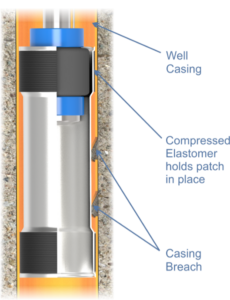
Cross-sectional view of a HydroFORM Liner™ sealing a damaged water well casing using compressed elastomer.

The blank liner is a liner without vulcanised elastomer. Using this lower-cost liner will reduce the overall cost of the repair. And since this part of the relining is not expanded or hydroformed, a PVC or FRP pipe can be used for the blank.

Cemented Relining with a Bottom HydroFORM Anchor

For severe structural failures where grouting the annulus is required, a hybrid approach utilises a single hydroformed section to support a cement column. The installation relies on a specialised straddle assembly comprising a High-Pressure (HP) HydroFORM packer, a straddle pipe, and a Low-Pressure (LP) cementing packer. This assembly is run inside the new liner to locate the HP packer at the expandable HydroFORM section at the bottom part of the liner. Because the two packers have separate inflation hoses, they can be operated independently.

First, the HP packer is inflated to swage or deform the base of the liner outward into sealing contact with the existing casing. This hydroformed section creates the lower anchor and bottom seal. While the HP packer remains inflated, the LP cementing packer is inflated higher up to isolate the one-way cementing valve located in the straddle zone between them.

Cement grout is then pumped down the drill rods, enters this isolated straddle zone, and is squeezed out through the valve to fill the annulus between the new liner and the original casing. The hydroformed part of the liner acts as the base for the cement column in the annulus. Once the annulus is filled, the LP cementing packer is deflated to flush out excess grout. Finally, the HP packer is deflated, and the setting tool is completely removed from the well.
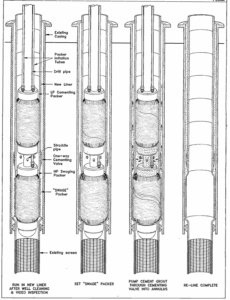
Step-by-step installation sequence of a HydroFORM Liner™ using cemented relining with inflatable packers.

The Hydroforming Installation and Verification Process

Setting tool deployment. The performance of the HydroFORM system relies on the precision of the setting tool and careful surface monitoring. The installation process begins by inserting the running tool, which serves as the high-pressure packer, into the unexpanded liner at the surface. This assembly is then run into the well to the desired depth.

Controlled expansion. Pressure is gradually increased within the packer until the steel liner yields and begins to expand. An important question during this phase is determining when the liner is fully set. This verification is achieved by comparing on-site data against pre-tested calibration values.

Surface verification. Before the operation, a liner-specific Pressure-Volume-Diameter characteristics envelope is generated off-site. During the actual run, operators continuously monitor the packer’s inflation pressure and the volume of fluid pumped. As the liner expands freely, the pressure curve follows a predictable unconfined expansion path. A distinct shift in the pressure-volume relationship indicates the point at which the liner reaches the casing wall.
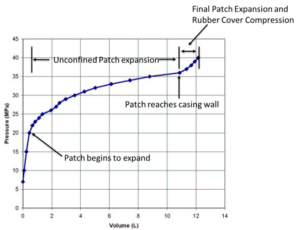
Pressure-volume calibration curve used to verify HydroFORM Liner™ expansion during casing repair installation.

Final setting and tool retrieval. Further pumping achieves the final expansion, compressing the vulcanised elastomer against the casing to complete the anchor. By comparing the real-time pumped volume and pressure against the established calibration chart, operators can verify the expanded size and confirm the installation. Following this confirmation, the internal packer is deflated and removed from the well.

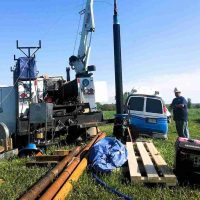
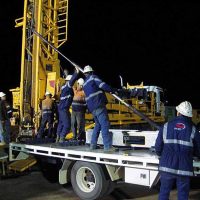
Operational considerations. Because the ends of the liner remain uncoated, the final result is a smooth, tapered transition. This design detail helps prevent future downhole equipment and pumps from hanging up on the liner. Because the hydroforming process relies on hydraulics rather than rotation or heavy push-down force, it can often be performed using a simple crane instead of a conventional drill rig, reducing mobilisation costs and scheduling constraints.

See the HydroFORM Liner™ in action below:


Conclusion

Selecting the appropriate casing repair method depends on the length, severity, and geometry of the damaged interval. Continuous HydroFORM lining is suited to localised or moderate casing damage, dual HydroFORM configurations can be used for longer damaged intervals where full-length expansion is not required, and cemented relining with a bottom HydroFORM anchor provides an option for severe structural failures requiring annular grout support. Across these configurations, the objective remains the same: to restore casing integrity while limiting the loss of internal diameter, supporting continued use of existing downhole equipment where practical, and maintaining hydraulic performance within the repaired well.

Learn more about the HydroFORM Liner™ here.

You May Also Like

News & Media

Our QHSE Policies and Practices

OEM & Custom Designs to Suit Your Needs

Dependable Technology for Demanding Applications

Our QHSE Policies and
Practices

OEM & Custom Designs to
Suit Your Needs

Dependable Technology for Demanding Applications

Stuart Brown

Director

Stuart recently joined IPI as the Director of Oil and Gas, bringing with him 15 years of diverse experience in the industry, with a strong focus on inflatable packers. His extensive background encompasses a variety of roles, including field engineering, operations management, sales, and business development. This breadth of expertise, coupled with his international experience in markets across North America, Europe, Australia, and the Middle East, positions Stuart to effectively lead and expand IPI’s oil and gas operations on a global scale. Stuart holds a Master’s degree in Mechanical Engineering from the University of Aberdeen and a Master’s degree in Finance from City University of London. His robust technical foundation and financial acumen uniquely empower him to drive strategic initiatives and foster growth within the company.

Masoud Jangani

Director

Masoud joined IPI Packers in 2022 as the Oil & Gas Region Manager for the Asia Pacific, bringing over 20 years of experience across operations management, technical sales, and business development in the resources sector. His diverse career spans both the mining and oil & gas industries, where he has held key leadership roles at global companies. In 2024, Masoud was appointed Director of the Mining, Water, and Geotech product lines (MWG), driving strategic growth and expansion across these sectors. Masoud holds a bachelor’s degree in engineering and graduate certificates in finance and business law.

Garry Taylor

Dave Knell

Director

David (Dave) Knell has been involved with the manufacture and application of inflatable packers for over 35 years. He started his career as an apprentice aged 15, and within a year, was running packers offshore, in Western Australia. Dave was the first employee of IPI and has been instrumental in the development of IPI’s manufacturing facility and capabilities. His knowledge of building packers is backed by extensive experience in the field, an innate understanding of real-world applications, and a fierce attention to detail. Dave is currently focused on expanding IPI’s ISO9001 certified manufacturing operations on a global scale, to better serve customers and to foster the continued growth of the company.

Francis Ford

Director

Francis joined IPI in 2005, based in Perth, Western Australia, as an apprentice. He developed his skills in manufacturing, tool and packer design and field operations across multiple industries – mining, water, civil/construction and oil & gas. His level of expertise and understanding enabled him to progress into leading IPI’s R&D efforts as manager. This included leading key custom / OEM designs and their practical developments, for multiple clients as well as continuing to progress the design and development of IPI’s unique systems. Now as engineering director, he is developing IPI’s engineering team to better support clients by improving our predictive packer modelling and fostering the continuous improvement of our packer tools and technology. A member of the Society of Petroleum Engineers and author of several technical papers, he is credited in several industry patents.

Joel Adams

Director

Joel Adams is a hydrogeologist, turned packer expert who has spent 30 years applying inflatable packer technology to complex downhole problems. His experience includes well testing for nuclear waste site characterization, water resources, water rights, rock stress testing, water well rehabilitation, and plug and abandonment (P&A). Joel has been leading the team as Director – North America since 2007 and has been associated with IPI, either as a key customer, agent or employee, since its founding in 1999. He led the introduction of IPI packer technology to P&A work, offshore in the Gulf of Mexico, and the establishment of DuraFRAC® packers as the market leader in the water well hydrofrac market. With numerous publications and presentations, Joel is a recognized expert in well testing and custom packer system design.

Howard Kenworthy

Director

Howard joined IPI in 2005 as commercial manager when IPI had 5 staff and was making customized product to order. His prior career was with UK public companies in retailing and financial services, leading operating companies. He holds an MBA which he took a few years after his degree from Oxford (Philosophy, Politics and Economics). He has led IPI’s distribution development with standard products and established most of IPI’s international operations as part of his role in business planning, finance and strategy. This included joint ventures in the USA, Chile and Indonesia. He was based in South East Asia 2015 to 2022, prior to relocating to Sharjah in the UAE, from where, as Commercial Director, he continues to develop and co-ordinate planning and strategy, the group’s global distribution and financial operations.

Clem Rowe

Founder and Executive Chair

Born and bred in Western Australia, Clem is a Curtin University graduate with a degree in mechanical engineering. Early in his career, Clem worked on offshore engineering projects in Western Australia and France. While working offshore, Clem was first exposed to inflatable packers, manufactured by a small Australian company that he subsequently joined in 1988 as Engineering Director. Clem established IPI in 1999 and has grown it from a small Western Australian manufacturing operation, to the world-wide manufacturing and distribution organization that it is today, by carefully selecting a competent team, that shares his values of quality, innovation and customer service. Clem is a member of the Society of Petroleum Engineers, the Institute of Hydrogeologists and the Institution of Engineers, Australia. He is the author of multiple articles and papers on inflatable packers and their application and has several international patents to his credit.

Our Company

Made Differently, Perform Better 

Discover why we’re the market leader for
Inflatable Packers across a variety of industries. 

Our Industries