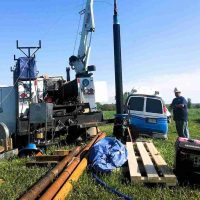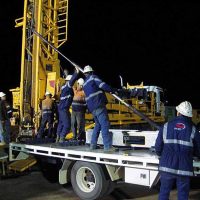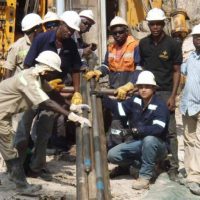

During underground mine developments, operators frequently need to drill holes into existing mine voids. These boreholes serve critical functions, ranging from ventilation to groundwater management. However, constructing and completing these boreholes presents a unique challenge: unlike conventional drilling, where the hole has only one open end, a borehole breaking through into a mine void has two open ends.
Because of this “breakthrough” scenario, traditional casing and cementing methods, which typically rely on a closed bottom or float shoe to hold the cement column, are often ineffective. Cementing a hole with an open bottom can lead to massive cement loss into the mine workings, compromising the well’s integrity and potentially damaging the mine infrastructure and further complicated with the presence of shallow aquifers.
Over the years, IPI Packers has engineered specialised solutions utilising advanced inflatable packer technology to tackle these precise scenarios. Our primary methods for overcoming breakthrough borehole challenges include the One-Shot Cementing System and the Drill & Drop Plug.
Here is an in-depth look at how these systems provide drillers and mine operators with reliable, efficient, and cost-effective solutions.
The One-Shot Cementing System is designed for efficient casing and screen running and enabling an ‘off bottom’ cementing operation in a single run. This system was designed originally for efficient water well completions but has great utility in breakthrough wells. The operation involves drilling the well to total depth (TD) or breakthrough and then running casing equipped with a One-Shot Cementing System (an inflatable casing packer and a cementing valve).
A mechanical setting tool is run within the casing on the drill pipe or work string and used to inflate the packer to a pre-set pressure. A valve automatically shifts at the right pressure, which seals off the packer and allows access to the annulus above the inflated packer for cement pumping. This streamlined process enables efficient off-bottom cementing when running casing and screens and is perfectly suited for breakthrough wells, as it eliminates the need for ‘tremie line’ cement jobs.
The casing packer plays a crucial role in this system by providing a reliable base for cement without compromising either the screens below or a gallery/tunnel beneath a breakthrough hole. The packer pressure is locked in through an integrated band check valve, allowing for a reliable packer seal. Especially important in breakthrough hole scenarios, where the packer holds the cement column firmly within the annulus, completely stopping it from falling through the open borehole and into the mine workings below. This ensures a secure and effective cement job with minimal operational risks, environmental impact and zero wasted grout. See the product in action below:
For a full list of applications, benefits, and technical specifications, please visit the One-Shot Cementing System page.
When operators need to create a temporary base for cement plugs in boreholes, the Drill & Drop Inflatable Plug provides a highly reliable, sacrificial bridge plug solution.
The system is deployed using standard drill pipe and inflated from the surface. It features an integrated check valve that traps the inflation pressure even after the workstring is disconnected. The true ingenuity of the Drill & Drop Plug lies in its external frangible deflation line. A sand plug is placed between the Drill & Drop Plug and the cement to provide a clean barrier that doesn’t lock the packer in place. During the cement clean-out process, a standard drill bit simply shears this line as it gets through the cement and the sand plug. This instantly deflates the packer, causing it to drop into the void below, eliminating the need for specialised fishing tools or complex milling operations. See the product in action below:
For a full list of applications, benefits, and technical specifications, please visit the Drill & Drop Plug page.
To illustrate the effectiveness of the Drill & Drop plug, consider a recent challenge brought to us by a client.
The Problem: A borehole drilled into mine workings was decanting water into the mine via a water-bearing fracture. The operator needed to seal the borehole below the fracture, pressure grout the fracture to stop groundwater ingress, and finally remove or drill out the packer to leave a clean, open hole that no longer allowed groundwater to flow into the mine.
The IPI Packers Solution: We proposed isolating the water production zone between a Drill & Drop Plug at the bottom and an IPI cement squeeze packer (RCP) at the top. Grout could then be pressurised into the isolated zone to seal the fracture as summarised in the following running procedure.
The operation begins by connecting the Drill & Drop plug to drill pipe and deploying it to a setting depth just below the fracture zone. Water is pumped from the surface through the pipe to inflate the plug, with an internal check valve locking in the pressure. Once set, the pipe are rotated to the right to disconnect and pump and pulled out of the hole, leaving the inflated plug securely in place with its small frangible deflation pipe and blind plug exposed.
Next, the IPI cement squeeze packer is connected to the drill pipe and run to the desired depth above the fracture. A drop ball is deployed down the tubing to close the string, directing pumped water into the packer element to inflate it. When the required inflation pressure is reached, the ball seat shears to reopen the string, allowing cement to be injected under pressure into the isolated zone between the cement packer and the Drill & Drop plug. After the fracture is successfully pressure grouted, pulling on the drill pipe shears the deflation pin, deflating the packer so it can be retrieved to the surface and redressed.
Once the injected cement has set, a standard drill bit is lowered to drill out the residual cement left in the bore. As the bit reaches the exposed brass pipe on the Drill & Drop Plug. This breaks the pipe, instantly releasing the inflation pressure and causing the plug to deflate and fall safely into the mine void below. If the dropped plug is easily accessible from within the mine workings, it can often be retrieved and reused if it remains in good condition.
Drilling into underground mine workings doesn’t have to result in compromised wellbores or complex, multi-stage completion nightmares. By utilising specialised inflatable packer technology like the One Shot Cementing System and the Drill & Drop Plug, operators can achieve secure, isolated, and efficiently cemented boreholes – saving rig time, protecting aquifers, and securing mine infrastructure.
To learn more about these systems, or discuss your specific borehole challenges, please contact the IPI Packers engineering team.
Stuart recently joined IPI as the Director of Oil and Gas, bringing with him 15 years of diverse experience in the industry, with a strong focus on inflatable packers. His extensive background encompasses a variety of roles, including field engineering, operations management, sales, and business development. This breadth of expertise, coupled with his international experience in markets across North America, Europe, Australia, and the Middle East, positions Stuart to effectively lead and expand IPI’s oil and gas operations on a global scale. Stuart holds a Master’s degree in Mechanical Engineering from the University of Aberdeen and a Master’s degree in Finance from City University of London. His robust technical foundation and financial acumen uniquely empower him to drive strategic initiatives and foster growth within the company.
Made Differently, Perform Better
Discover why we’re the market leader for
Inflatable Packers across a variety of industries.